Categories
GEO

YOYI TECH Debuts at NVIDIA APAC AI Marketing Week, Defining GEO as the New Battleground for Brand Influence

On January 20th, Cai Fang, COO of YOYI TECH, was invited to speak at NVIDIA’s APAC AI Marketing Week, delivering a presentation titled “From Content Marketing to AI Visibility: GEO Reshapes Brand Influence”.

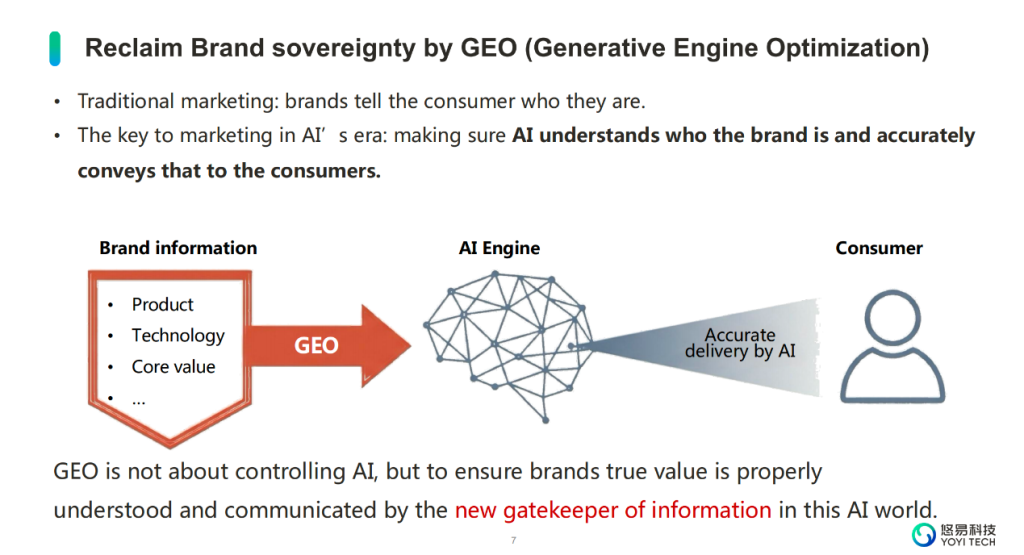
Amid the global wave of AI search, the battleground for brand marketing is undergoing a fundamental shift. Traditional search engine optimization (SEO) logic is no longer sufficient to address the challenges posed by generative AI. Brand influence now depends not only on rankings in search results but more crucially on being seen and accurately conveyed in AI-generated answers. This is the core mission of Generative Engine Optimization (GEO): in the AI era, helping brands reclaim narrative sovereignty and become the preferred and trusted information source for AI.

01 AI Reshapes Consumer Decisions, Brand Sovereignty at Risk of Erosion

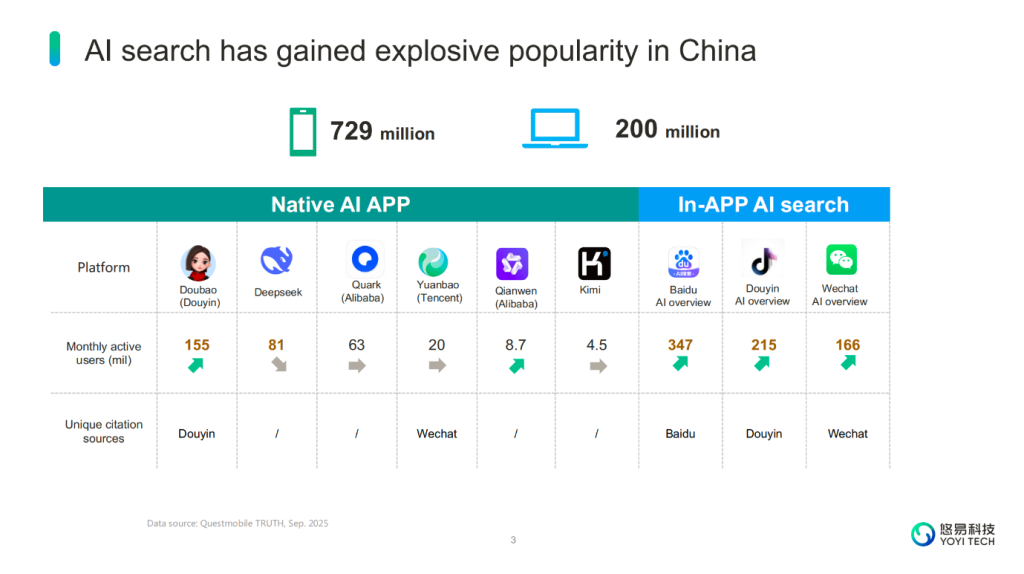
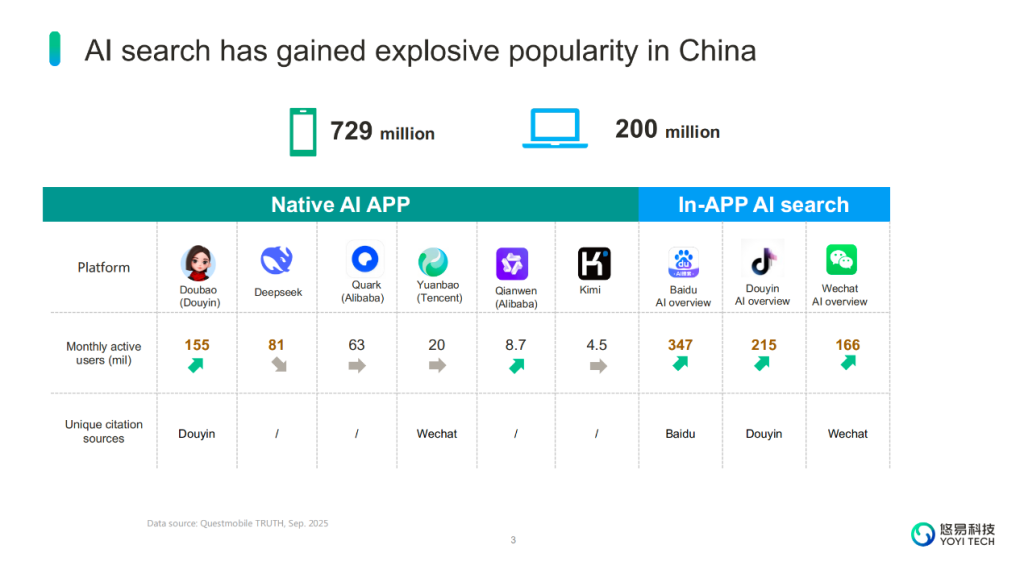
 AI applications in the Chinese market have experienced explosive growth. Native AI apps such as TikTok Doubao, Alibaba Tongyi, and Baidu AI, along with in-app AI features, now reach hundreds of millions of users. Consumers’ decision-making journey has shifted from the traditional “Search-Browse-Compare” to “Ask-Answer-Act”.
In this process, AI acts as the information gatekeeper, providing only information summaries rather than the traditional list of blue links. This means brands are either mentioned in AI answers or completely “invisible”.

An even more pressing challenge is the erosion of “brand sovereignty”: being overlooked (brand not appearing in AI answers), misinformation (AI conveying incorrect or outdated information), and being replaced (brand’s core intellectual assets used by AI but credited to competitors). There is a significant risk that traditional marketing investments may become ineffective in the AI era—if AI fails to understand your brand, billions in marketing spend could go to waste.

02 GEO: A New Language to Communicate with AI, Not Control It

GEO is not a simple upgrade of SEO. Its essence is building a language system that enables AI to understand accurately. The goal is not to control AI models in the “black box”, but to ensure that when AI retrieves, processes, and disseminates information, it can accurately capture and convey the brand’s true value, product advantages, and technical capabilities through optimized content.
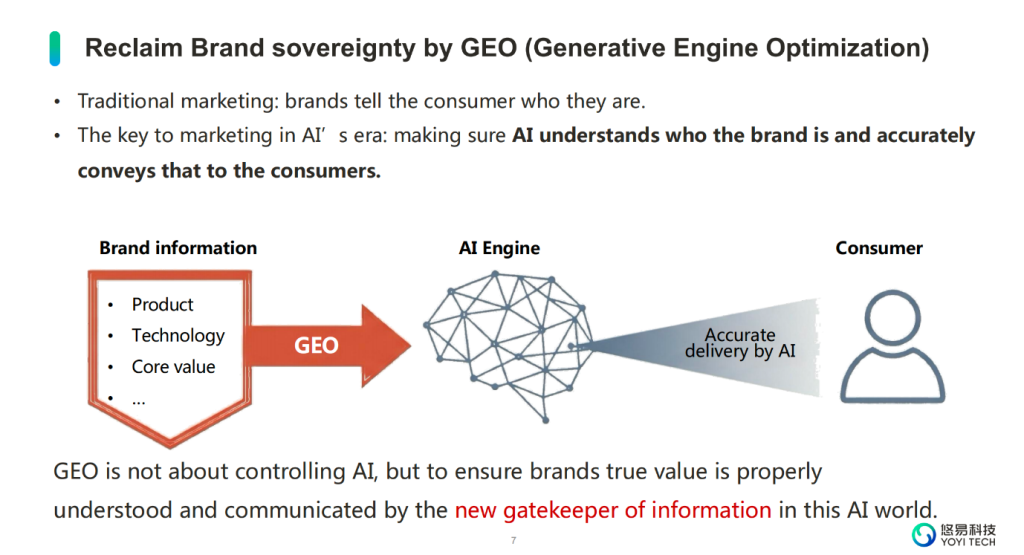
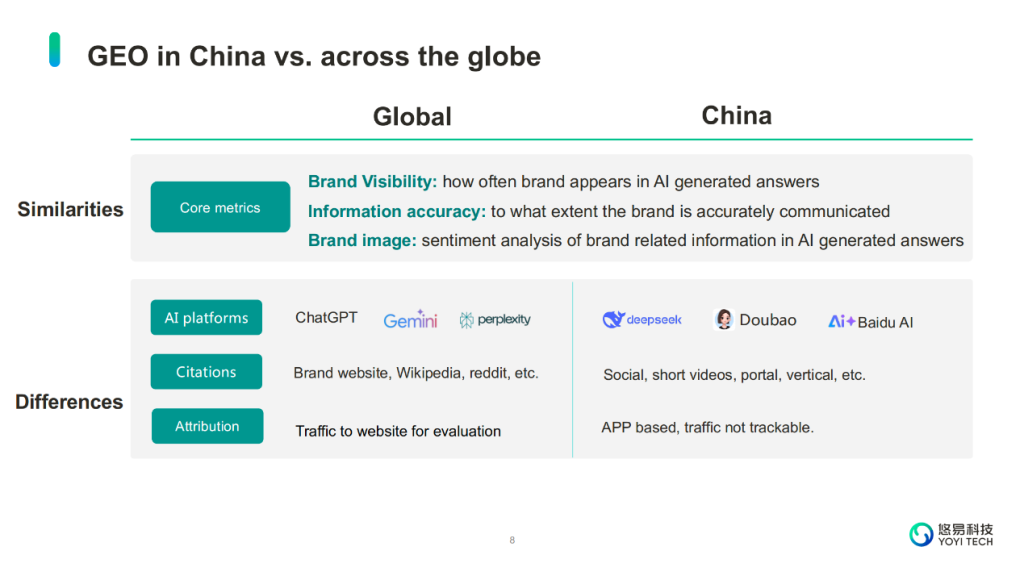
The core metrics for GEO include: Brand Visibility (frequency of brand appearance in AI-generated answers), Information Accuracy (extent to which brand information is conveyed without deviation), and Brand Image (sentiment orientation of brand-related content in AI-generated responses). Together, these metrics form the brand’s “digital identity” in the AI world.


03 Differences in Global Practices: China Focuses on Short Videos and “Brand Co-Creation”

 While GEO’s global objectives are consistent, there are significant differences in optimization environments and strategic priorities between China and overseas markets. Overseas, the core of optimization remains brand official websites, blogs, and Wikipedia, aiming to facilitate AI crawlers in accessing authoritative information. In China, however, the priority of brand official websites is relatively low, with short videos and social content becoming the main optimization frontiers.
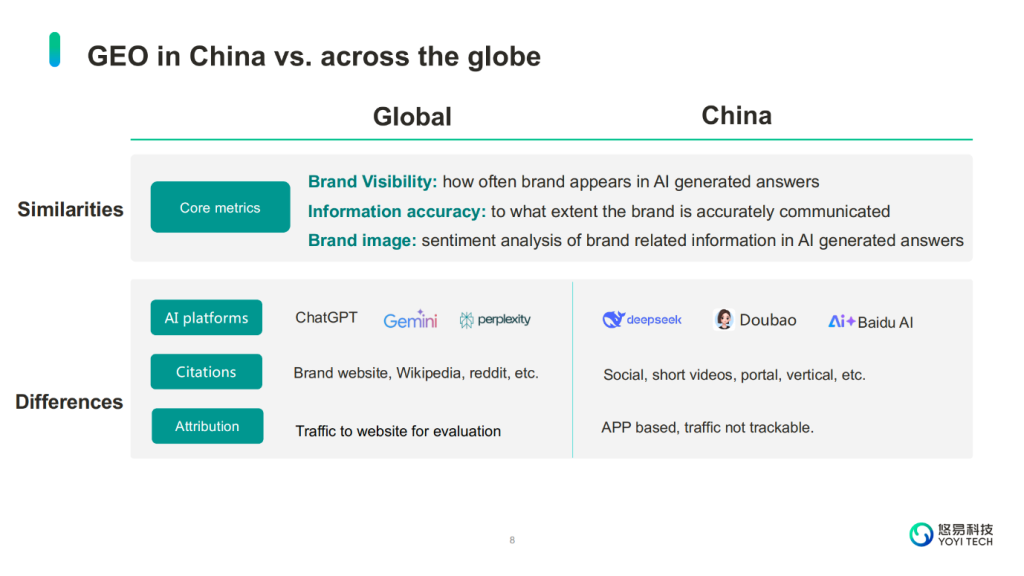
Additionally, the brand co-creation mechanism initiated by People’s Network can directly synchronize structured brand information to major domestic AI models, partially replacing the authoritative information source function of official websites.

As AI platforms such as Doubao and Qwen gradually integrate shopping features, GEO has become a key bridge connecting content marketing and AI instant shopping. China’s AI ecosystem is dominated by major “walled gardens”, resulting in a high degree of fragmentation in shopping links and content sources (e.g., Doubao mainly cites TikTok content, Yuanbao cites WeChat content), which further increases the complexity of unified GEO implementation.


04 Core Strategy: A Dual-Content System for “One Content, Two Uses”

An effective GEO content strategy requires brands to build a dual-content system for “one content, two uses”:

  1. Human-oriented content: Focuses on emotional resonance and brand storytelling, disseminated through social activities, PR campaigns, etc.
  2. AI-oriented content: Emphasizes factual statements, strictly adheres to the E-E-A-T (Experience, Expertise, Authoritativeness, Trustworthiness) principle, and adopts a clear Q&A format.

The key to optimization lies in maximizing the overlap between the two types of content to improve efficiency. For example, when creating Tiktok short videos, core keywords should be placed prominently in titles, descriptions, and tags to help AI quickly capture key brand and product information; at the same time, select high-authority media preferred by AI for content distribution.。


05 Key to Implementation: Cross-Departmental Collaboration and Long-Term Platform Construction

The successful implementation of GEO cannot be achieved by a single team; it requires integrating multiple departments including product, marketing, brand, PR, sales, and channels to form an AI-oriented collaborative workflow. From product information refinement and KOL content optimization to e-commerce page and review management, every link needs to incorporate AI-understandable thinking.

In the long run, a professional GEO platform is crucial for brand building. It can provide short-term monitoring and diagnosis of AI answers, and in the long term, construct the brand’s AI marketing knowledge base, continuously consolidating the brand’s authority and credibility in the AI world.


Conclusion

 AI search is not the future—it is happening now. GEO marks a new era in brand marketing, shifting from “competing for webpage clicks” to “competing for AI mindshare”. Brands that take the lead in mastering the language to communicate with AI and systematically building their AI visibility will gain a crucial first-mover advantage in the new battleground of reshaping influence, defending brand sovereignty, and even driving direct conversions.
 

Categories
GEO

YOYI TECH Shines at NVIDIA APAC AI for Marketing Week, Defining the New Battlefield of Brand Influence – GEO

January 20th saw YOYI TECH’s Chief Operating Officer Cai Fang invited to participate in NVIDIA APAC AI for Marketing Week, where she delivered a speech titled From Content Marketing to AI Visibility: GEO Reshapes Brand Influence.

As the wave of AI search sweeps across the globe, the battlefield of brand marketing is undergoing a fundamental shift. The logic of traditional Search Engine Optimization (SEO) is no longer sufficient to meet the challenges posed by generative AI. Brand influence no longer depends merely on rankings on search results pages, but more on the ability to be seen and accurately conveyed in AI-generated answers. This is the core mission of Generative Engine Optimization (GEO): in the AI era, to help brands regain narrative sovereignty and become the information source of choice and trust for AI.

01 AI Reshapes Consumer Decision-Making, Brand Sovereignty at Risk of Erosion

AI applications in the Chinese market are experiencing explosive growth. Native AI applications represented by Douyin Doubao, Alibaba Tongyi, Baidu AI, as well as AI features embedded in various platforms, have covered hundreds of millions of users. Consumers’ decision-making paths have shifted from the traditional “search-browse-compare” to “ask-answer-act”.

In this process, AI has become the gatekeeper of information, providing only information summaries instead of the traditional blue link lists in search results. This means a brand is either mentioned in AI’s answers or completely “invisible”.

An even more severe challenge lies in the erosion of brand sovereignty: being overlooked (the brand does not appear in AI answers), information distortion (AI disseminates incorrect or outdated information), and being replaced (the brand’s core intellectual assets are used by AI, yet the credit is attributed to competitors). There is a huge risk that traditional marketing investments may become ineffective in the AI era – if AI fails to understand a brand, billions in marketing spending could go down the drain.

02 GEO: A New Language for Communicating with AI, Not Controlling It

GEO is not a simple upgrade of SEO; its essence is to build a linguistic system that enables AI to understand information accurately. Its goal is not to control the AI models in the “black box”, but to optimize content to ensure that AI can accurately capture and convey a brand’s true value, product advantages and technological strength when retrieving, processing and disseminating information.

The core metrics for GEO include: Brand Visibility (the frequency of appearance in AI answers), Information Accuracy (whether the disseminated information is unbiased), and Brand Image (the emotional tendency of AI-generated content). These metrics together form a brand’s digital identity in the AI world.

03 Divergences in Chinese and International Practices, with Chinese Market Focusing on Short Videos and “Brand Co-creation”

While the global goals of GEO are consistent, there are significant differences in optimization environments and strategic priorities between China and the rest of the world. Overseas, the core of optimization remains brand official websites, blogs and Wikipedia, aiming to facilitate AI crawlers in capturing authoritative information. In China, however, brand official websites have lower priority, and the main optimization battlefield has shifted to short videos and social content.

In addition, the brand co-creation mechanism initiated by People’s Network can directly synchronize structured brand information to major domestic AI models, replacing the function of official websites as an authoritative information source to a certain extent.

As AI platforms such as Doubao and Tongyi gradually integrate shopping features, GEO has become a key bridge connecting content marketing with AI-enabled instant shopping. China’s AI ecosystem is dominated by major walled gardens, leading to a high degree of fragmentation in shopping links and content sources (e.g., Doubao mainly cites Douyin content, YuanBao cites WeChat content), which further increases the complexity of unified GEO implementation.

04 Core Strategy: A Dual Content System for “One Fish, Two Meals”

An effective GEO content strategy requires brands to build a dual content system of “One Fish, Two Meals”:

  • Human-centric content: Focuses on emotional resonance and brand storytelling, disseminated through social activities, PR campaigns and other forms.
  • AI-centric content: Focuses on factual statements, strictly abides by the E-E-A-T (Experience, Expertise, Authoritativeness, Trustworthiness) principles, and adopts a clear Q&A format.

The key to optimization is to maximize the overlap between the two types of content to improve efficiency. For example, when creating Douyin short videos, core keywords need to be placed prominently in titles, descriptions and tags to help AI quickly capture key brand and product information; at the same time, content should be published on high-authority media platforms that AI prefers to cite.

05 Key to Implementation: Cross-departmental Collaboration and Long-term Platform Construction

The successful implementation of GEO is not the achievement of a single team; it requires the integration of multiple departments including product, marketing, brand, PR, sales and channels to form an AI-oriented collaborative workflow. From product information refinement and KOL content optimization to e-commerce page and review management, an AI-understandable mindset needs to be embedded in every link.

In the long run, a professional GEO platform is crucial for brand building. It can provide short-term monitoring and diagnosis of AI answers, and in the long term, build a brand’s AI marketing knowledge base to continuously consolidate the brand’s authority and credibility in the AI world.

Conclusion

AI search is not the future – it is the present. GEO marks a new era for brand marketing, shifting from “competing for webpage clicks” to “competing for AI mindshare”. Brands that take the lead in mastering the language of communication with AI and systematically building their AI visibility will gain a crucial first-mover advantage in the new battlefield of reshaping influence, safeguarding brand sovereignty and even driving direct conversions.
 

Categories
GEO

What is GEO (Generative Engine Optimization)? A Comprehensive Guide

In 2025, as generative AI tools like ChatGPT, DeepSeek, and Doubao reshape user search habits, consumers’ shopping journeys have become heavily reliant on AI large language models (LLMs). Perplexity AI processes 780 million queries and attracts 129 million visits monthly, with a month-on-month growth rate exceeding 20%. The core challenge for enterprise marketing has shifted from traditional Search Engine Optimization (SEO) to content visibility in the AI search environment. According to data from Ahrefs and SparkToro, the probability of users clicking links on Google’s AI Overview pages has dropped by 20% to 50%. The internet has entered the “zero-click” era, where users prefer to obtain direct answers rather than clicking links—meaning the main battlefield for traffic competition is shifting from “listings pages” to “answer layers.”

Amid this new trend, GEO—Generative Engine Optimization—has emerged rapidly in China’s brand marketing market like mushrooms after rain. The marketing industry is evolving from “data-driven” to “data + model-driven,” spawning numerous new marketing scenarios. Consequently, a brand-new optimization strategy—Generative Engine Optimization (GEO)—has come into being. Faced with this “blue ocean,” many enterprises are confused: “What exactly is GEO? What are its core and essence?”

I.The Principle of LLM Cognition Formation: Understanding How AI “Thinks”

To comprehend why GEO works, it is essential to first grasp the underlying logic of how AI large models form cognition. Unlike the linear “crawl-index-rank” process of traditional search engines, the cognitive process of generative AI is a networked flow of “understanding-reasoning-creation.”


1.Multi-source Cognition

AI’s cognition is not based on a single information source but integrates its massive training corpus, real-time retrieved web information, and knowledge base inputs. This means the consistency of brand information across all online channels—such as official websites, authoritative media, industry forums, and user reviews—is crucial. Information fragmentation or contradictions are key risks leading to AI cognitive biases. LLMs’ understanding of the world primarily relies on two complementary core mechanisms:


a) “Inherent Cognition” Based on Pre-trained Knowledge

Principle: During the training phase, LLMs learn from massive, static corpora (e.g., internet texts, books, papers up to a specific date) to form a foundational, rule-based knowledge system. This knowledge is internalized into the model’s parameters, serving as its “common sense” and “background knowledge base” for answering questions.


b) “Dynamic Cognitive Supplement” Based on Retrieval-Augmented Generation (RAG)

Principle: To address the limitation of outdated pre-trained knowledge and acquire the latest, most specific information, modern AI search systems widely adopt RAG (Retrieval-Augmented Generation) technology.

Process: When a user asks a question, the system does not rely solely on the model’s internal knowledge. Instead, it performs real-time web searches or queries designated external knowledge bases (e.g., brand official websites, news, industry reports). Relevant, up-to-date document snippets retrieved are used as context, which—together with the question—is input to the LLM. The model then generates answers based on this fresh information.

Diagram: RAG Technology Flowchart


2.Generative Reasoning:AI does not simply match keywords; instead, it conducts dynamic reasoning based on semantic understanding and context to organize and generate answers. It prefers content with clear logic, complete structure, and sufficient evidence. Therefore, GEO requires content to have a clear semantic chain that can naturally integrate into AI’s generative logic, rather than just keyword stuffing.

3.Preference for Authority and Evidence AI systems highly value the authority and credibility of information. They tend to cite content from authoritative media, industry reports, expert opinions, or sources containing specific statistical data and research methods. Brands need to build “entity authority” recognized by AI by publishing original research and whitepapers, and maintaining consistent information across all platforms.


II.Core Definition and Essence of GEO: A Strategic Leap from “Being Indexed” to “Being Generated”

Based on this underlying AI logic, GEO is a strategic practice aimed at optimizing digital content to enhance its visibility and citation rate in AI-driven search engines such as DeepSeek, Doubao, Kimi, and Yuanbao. Its core goal is no longer to improve webpage rankings on traditional search engine results pages (SERPs) but to ensure that brand content is understood and trusted by AI, and cited or recommended as part of the answer. Research from Princeton University shows that GEO optimization can increase content visibility by up to 40% across diverse AI search queries, while traditional keyword stuffing techniques have limited effectiveness on large language models.

The fundamental difference between GEO and traditional SEO lies in the paradigm shift of optimization objectives:

Traditional SEO is a “positional warfare” centered on “ranking.” Its goal is to improve webpage rankings for specific keywords, with core metrics including keyword ranking, Click-Through Rate (CTR), and organic traffic. It optimizes “links”—users must click through to access information. Brands need to defend their keyword positions against competitors.

GEO aims to get brands cited and mentioned in AI-generated direct answers, with core metrics including citation rate, mention frequency, information accuracy, and sentiment index. It optimizes “language” and “entities”—AI directly integrates information to provide answers, eliminating the need for users to click links. Its core feature is optimizing content to improve the quality of citations in AI-generated answers, rather than just rankings. Key metrics include:

  • Citation word count (the amount of content adopted in AI answers)
  • Position-adjusted word count (weighted value considering the location of citations)
  • Subjective impression (comprehensive assessment of citation relevance, credibility, sentiment index, etc.)

This difference stems from the fundamentally distinct operational logics of AI and traditional search engines. Traditional search engines discover and display information through a linear “crawl-index-rank” process, while AI LLMs generate new answers by understanding, reorganizing, and creating information through a networked “understanding-reasoning-creation” process. Therefore, the essence of GEO is a “return movement” of brand value.


III. How GEO Works: A Complete Process from Content Optimization to Cognitive Implantation

GEO is not an overnight effort but a systematic, continuously optimized closed-loop process. Its core workflow can be summarized in four key stages:

1.Monitoring and Diagnosis

First, systematically monitor the brand’s current status on target AI platforms. By simulating real user queries, analyze whether the brand is mentioned in AI answers, its ranking position, the accuracy of information, and sentiment tendency. This is equivalent to a comprehensive health check of the brand’s “cognitive status” in the AI world.


2.Strategy and Content Optimization:Based on diagnostic results, develop optimization strategies. The core is to produce content preferred by AI:

a)Answer-first approach: Provide direct, clear answers to questions using a Q&A structure.

b)Build authority: Integrate specific data, expert quotes, and original research, and ensure consistent information across platforms.

c)Optimize structure: Use headings, lists, tables, etc., to make content easy for AI to parse, and deploy Schema structured data markup (e.g., FAQ, How-to) to help AI understand content context.

d)Multi-platform distribution: Distribute optimized content to authoritative platforms frequently cited by AI, such as vertical industry websites, Zhihu, and knowledge bases, to build a consistent online knowledge graph.


3.Training and Influence

Continuously and systematically feed high-quality, structured, authoritative brand content into AI’s “information sources” to gradually “educate” and train AI models. When AI processes relevant user queries, it will prioritize extracting and trusting these brand information that it has “familiarized” and “verified” from the massive amount of information it has trained on and retrieved, integrating it into the generated answers.


4.Verification and Iteration

Continuously track the effect of optimization, monitor changes in the brand’s citation rate, ranking, and sentiment in AI answers. Based on feedback data, constantly adjust content strategies and distribution channels to form a continuous cycle of “monitoring-optimization-verification-re-optimization,” stabilizing and enhancing the brand’s position in AI cognition.


Conclusion: Core Value and Future of GEO—Building a “Certain” Moat in the AI Era

The future of search is generative, conversational, and AI-driven. As platform mechanisms become increasingly transparent and third-party monitoring tools mature, GEO is expected to evolve from “uncontrolled growth” to “refined operation.” In this process, professional solutions represented by YOYI GEO Agent Mentis are transforming GEO from theory into a measurable and executable brand growth engine through a systematic full-link closed loop of “monitoring-diagnosis-optimization-verification.” For enterprises seeking future growth, GEO has shifted from an “optional” to a “required course.” It requires brands to adopt a long-term perspective, systematically accumulate knowledge assets, and build an authoritative system recognizable and trusted by AI, thereby preparing to be jointly chosen by users and AI when the “intelligent selection era” arrives.


References

[1] OtterlyAI_Generative_Engine_Optimization_Guide

[2] seo_in_the_age_of_ai

[3] Generative-AI-and-LLMs-for-Dummies

[4] 2025 China GEO Industry Development Report – AI Marketing Application Working Committee of China Commercial Advertising Association (October 22, 2025 Edition)

[5] Zhiyu AI AI Marketing Era Solutions

[6] Generative Engine Optimization (GEO) 2025 Complete Guide: How to Win in AI Search


Exit mobile version